
Cobb County Superior Court Overview
The Cobb County Superior Court is the top trial court in the county. It sits in the heart of downtown Marietta. The main court address is 70 Haynes Street, Marietta, GA 30090. The phone line is (770) 528-1800. The fax line is (770) 528-1808. Office hours are listed Monday through Wednesday from 8 a.m. to 5 p.m. on the court's official contact card. The court shares its building with the Clerk of Superior Court and the District Attorney. Together they form the bulk of the Cobb judicial complex on Haynes Street.
The court is a court of general jurisdiction. That means it can hear almost any type of case under state law. It is the only court in Cobb that can grant a divorce or quiet title to land. It is the only local court that can try a felony or impose a death sentence. The court also hears equity cases, large civil suits, and appeals from lower county courts. Most jury trials in Cobb happen here. For an official overview of how Georgia's courts fit together, see the Georgia Courts hierarchy page.
The Cobb County government keeps a court overview page that lists each court in the complex. It links to Superior, State, Probate, Juvenile, Magistrate, and other offices. Cobb's Superior Court works closely with the Clerk's office. The clerk holds and shows all Superior Court files. Cobb residents can also look up case records through the Clerk's records search hub.
The county's court overview lists the Superior Court Clerk's office at the same Haynes Street address. The bench has ten elected judges. Each serves a four year term. The court is part of the Cobb Judicial Circuit. That circuit covers only Cobb County. Cobb is one of the few large Georgia counties that has its own single county circuit.
Jurisdiction and Case Types in Cobb Superior Court
Cobb Superior Court has broad power. It hears felonies, divorce, title to land, equity, and other major civil suits. It also hears habeas corpus cases. The court can issue injunctions and other equitable relief. Death penalty cases are tried here. The court can also handle child support, name change, legitimation, contempt, and adoption matters. Adoption files are sealed by state law. Divorce decrees, by contrast, are open records held by the Clerk of Superior Court.
The Cobb judicial system splits work by case type. The Superior Court takes the heavy stuff. The Cobb State Court takes traffic, misdemeanor, ordinance, and many smaller civil suits. The Magistrate Court takes small claims under $15,000, dispossessory, garnishment, and warrant applications. The Probate Court takes wills, estates, guardianships, marriage licenses, and weapons carry permits. Juvenile Court takes cases with children under 18. Each court has its own clerk and its own records portal.
Civil filing categories at the Superior Court Clerk include general civil, adoptions, divorces, and name changes. The base civil filing fee is $218. Post judgment filings after 30 days run $58. A subpoena is $5. Sheriff service is $50 per party when the address is in Cobb. The full fee table is on the Clerk's fees page. The Clerk's office accepts cash, money order, certified check, and credit or debit card. Card payers must sign in person with photo ID.
| Court | Address | Phone | Case Types |
|---|---|---|---|
| Superior Court | 70 Haynes Street, Marietta, GA 30090 | (770) 528-1800 | Felonies, divorce, title to land, equity, jury trials |
| State Court | 12 East Park Square, Marietta, GA 30090 | (770) 528-2622 | Misdemeanors, traffic, ordinance, civil matters |
| Magistrate Court | 32 Waddell Street, Marietta, GA 30090 | (770) 528-8900 | Small claims, dispossessory, garnishment, warrants |
| Probate Court | 32 Waddell Street, Marietta, GA 30090 | (770) 528-1900 | Estates, guardianship, marriage, weapons permits |
| Juvenile Court | 32 Waddell Street, Marietta, GA 30090 | (770) 528-2220 | Cases involving children under 18 |
That table shows the basic split of work across Cobb's trial courts. The Superior Court is the lead court for serious matters.
Cobb Superior Court Judges
The Cobb Superior Court bench has ten elected judges. Each judge serves a four year term. The judges share work across civil, criminal, and family dockets. They also sit on accountability court matters when assigned. The Clerk's about page confirms that each Georgia county has a Superior Court made up of judges and a clerk. The clerk is Connie Taylor. She is the constitutional officer who holds the court's records.
Judges set their own civil and criminal calendars within the court's local rules. Some judges run specialty dockets. Judge Jason D. Marbutt presides over the Cobb Drug Treatment Court. Other judges take on Mental Health Court, Veterans Treatment Court, and Parental Accountability Court. Standing orders set scheduling rules for divorce and family law cases. The standing orders are posted on the Superior Court forms page.
Each judge has a staff team that includes a law clerk, a court reporter, and a calendar clerk. Hearings and trials happen in courtrooms at 70 Haynes Street. Jury parking lots and a parking deck are nearby. The Sheriff provides court security at all judicial buildings 24/7 under O.C.G.A. § 15-16-10(a)(2).
Cobb Judicial Circuit and Districting
The Cobb Judicial Circuit covers only Cobb County. It is one of the few single county circuits in Georgia. Most circuits group two or more counties. Cobb's size and case load justify its own circuit. The court is part of the broader state trial court system. The state court system is run under the Judicial Council of Georgia.
Within the circuit the Superior Court is the lead trial court. The District Attorney's office prosecutes felony cases here. The Solicitor General handles traffic, misdemeanor, and ordinance cases over in State Court. The Circuit Defender, also called the Public Defender, handles felony defense for those who qualify. The Georgia Public Defender Council Cobb Circuit page covers defender services for the circuit.
Cobb's district lines do not change much. The court keeps a stable bench. Cases are assigned by case type or by random draw based on local rules. Family law cases often go to a small group of judges who take most divorce and custody matters. Major felony cases may go to whichever judge has the open calendar slot.
How to Search Cobb County Superior Court Cases
The main case lookup tool is the Clerk's WebCaseManagement portal. The system holds civil and criminal Superior Court records. It also pulls in some State Court records under the same case type filters. Public users get VIEW access for free. Attorneys and court officials log in through a separate box on the same page. The Clerk's records search hub is the official entry point. The hub links to the WebCaseManagement search and to the real estate index. Other county case search hubs are listed on the county's information about courts page.
The Clerk's duties page walks through the records-search landing for Cobb Superior Court and notes that the Superior Court Clerk is one of four elected constitutional officers in each Georgia county.
The search portal itself is a Tyler-style case management page. Cobb's WebCaseManagement search opens with a public VIEW frame.

The interface lets users pick civil or criminal, enter a case number, party name, CSE number, or use system wide search. Civil filters include Domestic, Superior Civil, Child Support, State Civil, and Habeas Corpus. Criminal filters include Superior Court and State Court. The page also has a shopping cart, which signals that some document copies may carry a fee.
- Open the Clerk's records search hub and accept any on screen notice.
- Click civil or criminal based on the case type. If unsure, run both.
- Enter a case number in exact form, or use a party name.
- Set the Filed From and Filed To dates if needed.
- Use court type checkboxes to narrow the result set.
- Open Case Details for the file you want. Use Documents to view filings.
For real estate, deed, and lien records, use the search hub's real estate link. For criminal record restriction, see the Georgia Courts record restriction guide or visit our criminal records page.
How to File in Cobb Superior Court
Most filings in Cobb Superior Court go through the Clerk of Superior Court. The clerk's main office is at 70 Haynes Street. The Real Estate Division is at 10 East Park Square, Building C. Civil and family cases are filed at the main office. Real estate, deed, and lien filings go to the Real Estate Division. The Clerk's about page lists Connie Taylor as the clerk and explains the clerk's role under Georgia law.
Filing fees are paid at the time of filing. The general civil rate is $218. Adoptions, divorces, and name changes also use the $218 civil rate. State agency filings drop to $89. Local agency filings drop to $74. Post judgment filings after 30 days are $58. A subpoena costs $5. A notary commission is $55. Sheriff service is $50 per party. Publication runs $120 in most cases and is paid by money order or certified check to the Marietta Daily Journal. The Clerk's full fee schedule is online.
The Clerk accepts cash, money order, cashier's check, certified check, and credit or debit cards. Card payers must appear in person with photo ID. The Clerk does not accept filings by fax or email. E-filing is available for many case types through the state's PeachCourt platform and other state trial court tools. The duties page outlines what the Clerk's office can and cannot do. Staff can locate files and explain filing steps. Staff cannot give legal advice.
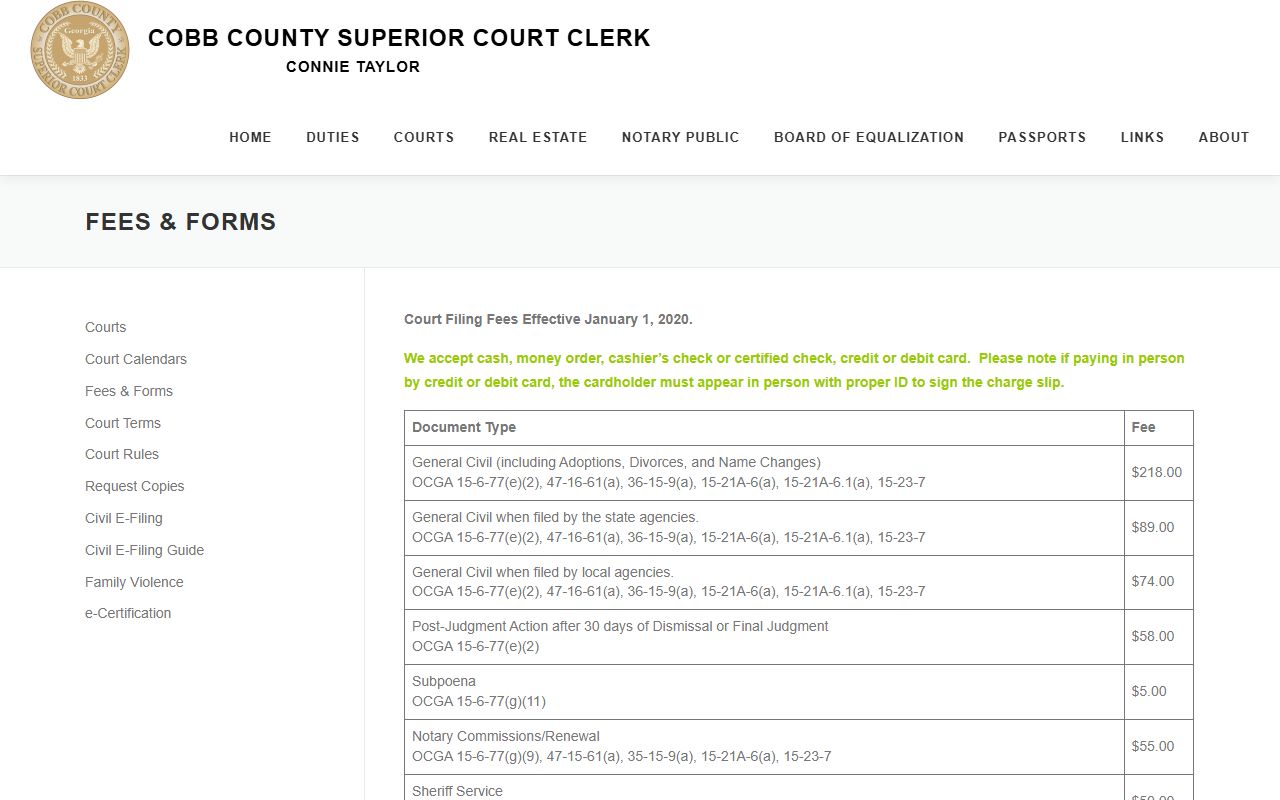
The fee table above shows civil filing rates, sheriff service costs, and publication fees that apply to most Superior Court filings.
Cobb Superior Court Forms
The Superior Court forms page is the main spot for family law packets and other Superior Court forms. The Cobb Superior Court keeps the page current with standing orders and local packets. Forms include Divorce With Children, Divorce Without Children, Child Support Modification, Contempt, Legitimation, Declaration of Sole Custody, Name Change of Adult, Name Changes of Children, Correct a Birth Certificate, and Poverty Affidavit.
Most packets are PDF forms. Users fill them out, sign them, and bring them to the Clerk for filing. Some packets need a notary stamp. The Clerk's office can notarize for $55. The poverty affidavit lets a filer ask the court to waive filing fees if they cannot pay. The court reviews the affidavit and decides whether to grant the waiver.
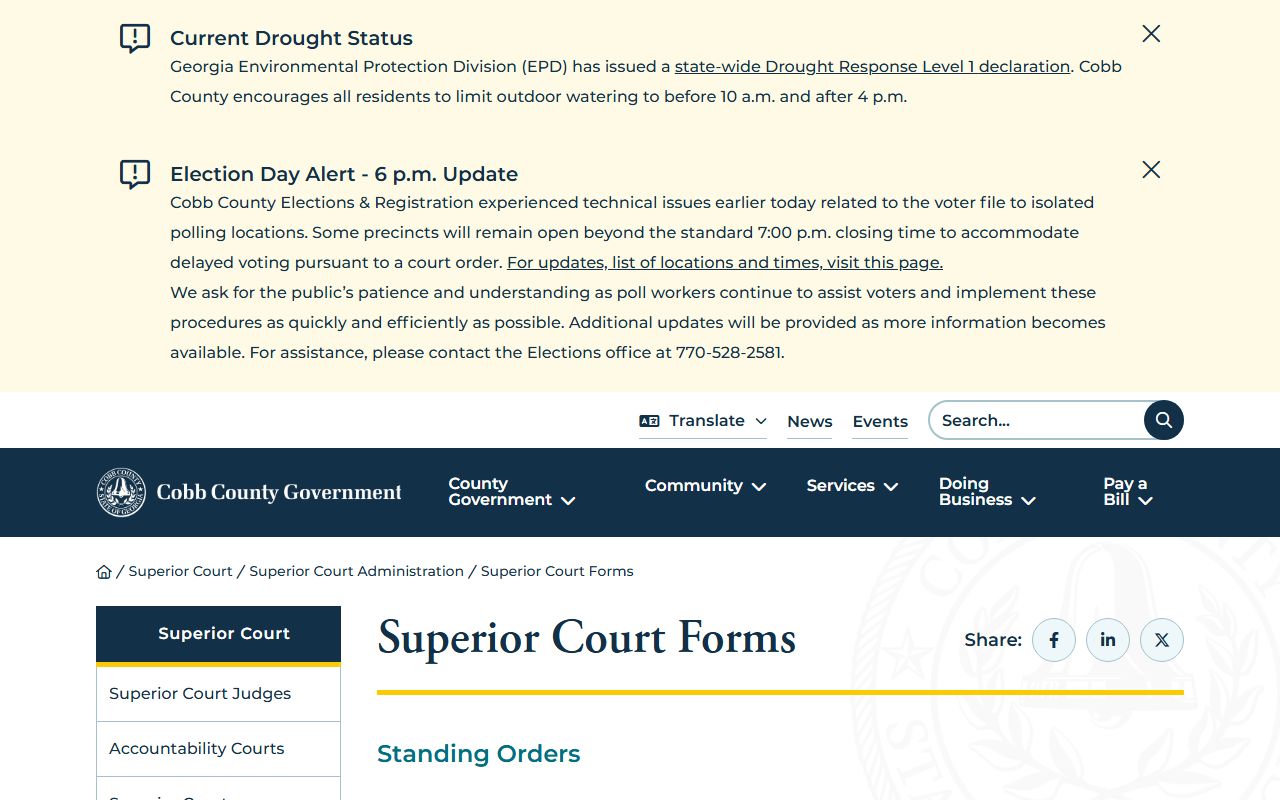
The forms page above links each Superior Court packet. The full list is at the official Superior Court forms page. For marriage and divorce record copies after the case closes, see the marriage and divorce records page.
Note: Clerk staff cannot tell a filer what to file or how to argue the case. Pro se filers should review packet cover sheets and instruction sheets carefully before filing.
Superior Court vs State Court vs Magistrate Court
Cobb runs three trial courts side by side. Each takes a different slice of work. The chart below shows how the courts differ. The Superior Court is the only court that can grant a divorce or try a felony.
| Superior Court | State Court | Magistrate Court | |
|---|---|---|---|
| Case Type | Felonies, divorce, title to land, equity, large civil | Misdemeanors, traffic, ordinance, civil suits | Small claims, dispossessory, garnishment, warrants |
| Criminal Limit | All felonies including death penalty | Misdemeanors only | Warrant applications and first appearance |
| Civil Amount | No upper limit | Set by statute, broad civil | Up to $15,000 in small claims |
| Jury Trials | Yes, including 12 person felony juries | Yes, for many civil and criminal cases | No jury trials |
| Appeals From | Court of Appeals of Georgia or Supreme Court of Georgia | Court of Appeals of Georgia | Appeal to State Court or Superior Court |
That side by side view helps a user pick the right court before filing or searching. Most felony cases start in Magistrate Court at first appearance and then move up to Superior Court for trial.
How a Case Moves Through the Cobb Court System
The flow of a case depends on the case type. Felony cases follow one path. Small civil cases follow another. The court structure is set out on the Georgia Courts navigation page.
For a felony case, the path looks like this:
- Arrest by police or Sheriff deputies.
- First appearance in Magistrate Court within 48 to 72 hours of arrest.
- Bond decision and preliminary hearing as needed.
- Indictment by grand jury or accusation by the District Attorney.
- Arraignment in Superior Court.
- Pretrial motions and discovery in Superior Court.
- Plea or jury trial in Superior Court.
- Sentencing by the Superior Court judge.
- Appeal to the Court of Appeals of Georgia or the Supreme Court of Georgia.
For a small civil claim, the path is shorter:
- File a small claim in Magistrate Court for up to $15,000.
- Hearing before a magistrate.
- Judgment or dismissal.
- Either party may appeal de novo to State Court within 30 days.
- From State Court, further appeal may run to the Court of Appeals of Georgia.
For a divorce, the case is filed in Superior Court and stays there. There is a 30 day waiting period from service before a judge can grant the final decree. For records of past divorces, the Clerk of Superior Court holds the file.
Accountability Courts (Drug, Mental Health, Veterans, DUI)
Cobb Superior Court runs several accountability courts. These are special dockets for people whose criminal cases stem from substance abuse, mental illness, military trauma, or repeat impaired driving. The court's accountability courts hub lists the programs and their phone lines. All sit at 10 East Park Square, Suite 200, Marietta, GA 30090.
The Drug Treatment Court is a state certified program for high risk, high need adults with substance use disorders who face felony charges in Cobb Superior Court. The program runs 18 to 24 months. Judge Jason D. Marbutt presides. The five phase model includes Phase 1 at 12 weeks, Phase 2 at 12 weeks, Phase 3 at 20 weeks, Phase 4 at 12 weeks, and Phase 5 at 22 weeks. Random drug screens run at least one to two times per week. Eligibility requires age 17 or older, legal U.S. residency, a stable sober address in Cobb, and a voluntary plea decision. The official Drug Treatment Court page lists the exclusions, which include sex offender status, serious violent felony charges, gang ties, and felony firearm counts.
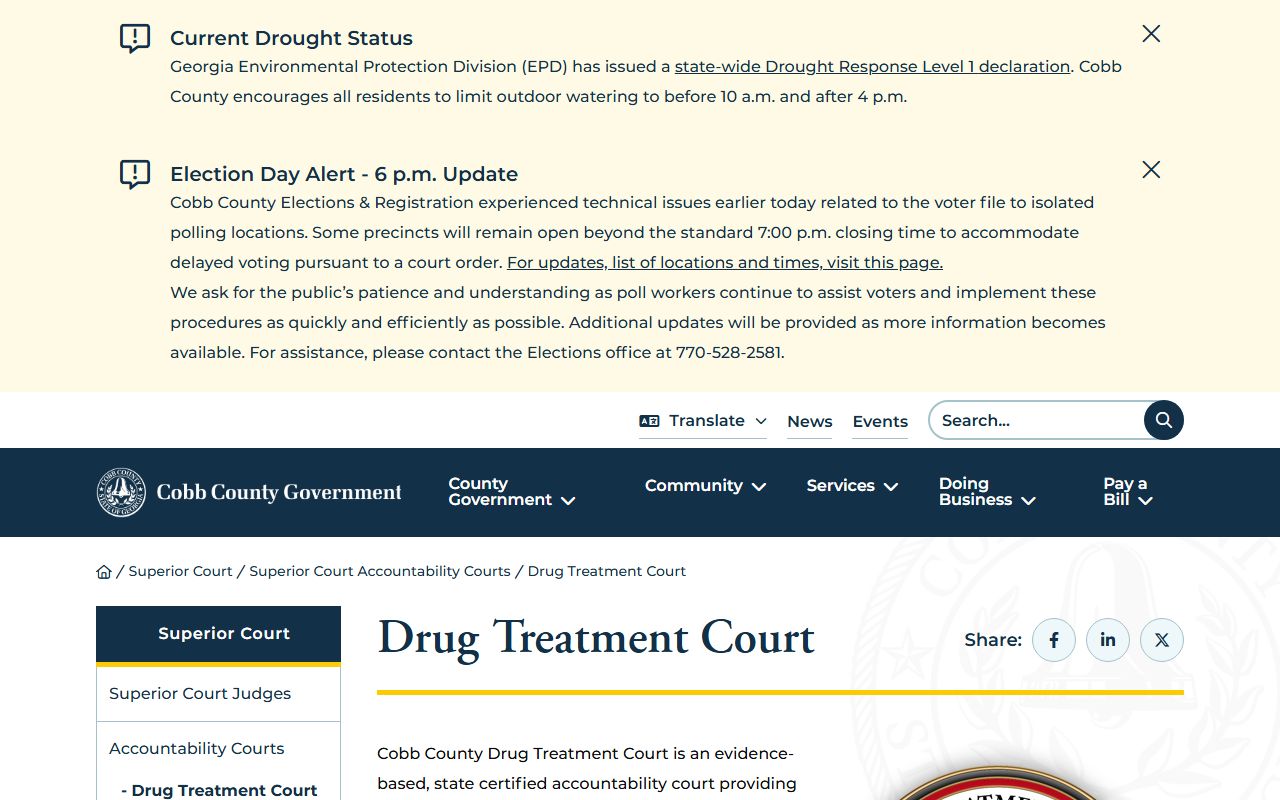
That program page covers benefits like less jail time, possible charge reduction or expungement, treatment access, and help with housing and jobs.
The Mental Health Court phone is (770) 528-8106. It serves Cobb defendants with serious mental illness. The Veterans Treatment Court phone is (770) 528-7988. It serves veterans whose cases tie back to military service. The Parental Accountability Court phone is (770) 528-3616. It supports parents with child support compliance. Cobb does not list a Superior Court DUI Court at the Drug Treatment Court level. DUI cases are normally handled in State Court, but felony or repeat DUI cases that move into Superior Court may be referred into Drug Treatment Court when the criteria fit.
Appeals from Cobb Superior Court
Most appeals from Cobb Superior Court go to the Court of Appeals of Georgia. Some case types go straight to the Supreme Court of Georgia. The Supreme Court hears all death penalty appeals. It also hears election cases, certain constitutional questions, and habeas appeals. The Court of Appeals hears most other matters. Both courts sit in Atlanta. Their dockets and case search tools are linked from georgiacourts.gov.
The notice of appeal is filed with the Cobb Superior Court Clerk. The clerk then prepares the record and sends it to the appellate court. Filing deadlines are tight. A notice of appeal is generally due 30 days after the order being appealed. Cross appeals are due 15 days after the first notice. A pro se filer or party should confirm the rule that applies to their case type before relying on these dates. Appellate filing fees and rules are set by the appellate courts.
A losing party in an appeal to the Court of Appeals may seek further review by the Supreme Court of Georgia. That review is discretionary. The Supreme Court takes only a small share of petitions. Federal questions can sometimes be taken to the U.S. Supreme Court after state remedies are exhausted. For federal cases that begin in federal court, see the U.S. District Court for the Northern District of Georgia.
Cobb County Superior Court Address and Contact
The court has two main contact points for the public. The first is the court administration office. The second is the Clerk of Superior Court. Both share the same Haynes Street address. The Real Estate Division is in a separate building on East Park Square.
Cobb County Superior Court
70 Haynes Street
Marietta, GA 30090
Phone: (770) 528-1800
Fax: (770) 528-1808
Hours: Monday to Wednesday, 8 a.m. to 5 p.m.
Clerk of Superior Court (Connie Taylor)
70 Haynes Street
Marietta, GA 30090
Phone: (770) 528-1300
Real Estate Division: 10 East Park Square, Building C, (770) 528-1360
Web: superiorcourtclerk.cobbcounty.gov
For Clerk specific topics like certified copies and records requests, see the Clerk of Superior Court page. For records held by Cobb State Court Clerk Tahnicia Phillips, see the Clerk of State Court page. For dockets and broader case lookup, see the court records page. Sheriff bailiffs and security control techs cover the courthouse around the clock under O.C.G.A. § 15-16-10(a)(2). Plan for a security check on entry.
Note: Cobb's State Court Clerk is launching a drive through court service for fine and citation payments in 2026, a first in Georgia, separate from Superior Court matters.