
How to File a Cobb County Open Records Request
Open records requests in Cobb County go straight to the office that holds the file. There is no single county portal that routes every ask. The Sheriff has its own Open Records line. The Clerk of Superior Court takes its own requests. The Clerk of State Court does the same for traffic and misdemeanor records. Probate, Magistrate, and the District Attorney each handle their own queues. Pick the right office first. That one choice saves the most time.
A short, clear request works best. Name the record. Give a date range. Add a case number or a person name if you have one. Ask for the format you want. Email is fine for most offices. Some still take paper. The Cobb Sheriff lists a dedicated Open Records phone line at 770-499-4728. The county's main hub for court files sits at the Cobb County search judicial records page, which routes you by court type.
- Pick the right office. Court files go to the clerk for that court. Sheriff files go to the Sheriff. Tax, deed, and business filings go to the Clerk of Superior Court. The county judicial hub at cobbcounty.gov/i-want-to/search-judicial-records points you to each one.
- Write the request in plain words. Name the record. Add dates, names, case numbers, or a topic. Vague asks slow the office down.
- Pick a format. Paper copies cost more. Email or PDF is often free or cheap. Say which one you want.
- Send it. Most Cobb offices take email. The Sheriff posts a direct Open Records phone line. The Clerk of Superior Court and the Clerk of State Court list mailing and walk-in options on their sites.
- Wait for a reply. State law sets the clock at three business days for an answer. The answer may be the records, a cost estimate, or a list of files that need more time.
- Pay any fees due. Some offices ask for a deposit before they pull a large file. Pay it. The clock can pause until you do.
- Get the records. Check them. If a part is held back, the office must cite the statute that lets them hold it.
What the Georgia Open Records Act Covers
Georgia's Open Records Act lives at O.C.G.A. §§ 50-18-70 through 50-18-77. The law starts with a strong rule. Public records are open. The state's policy favors open government. The act covers all agencies that fall under it, which is a broad list of state, county, and city bodies. The Georgia Attorney General runs a public guide to the law. That guide sits at the Georgia AG open-government law page and the AG open-government FAQ.
The act sets a few key rules. Anyone can ask. You do not have to live in Georgia. You do not have to give a reason. The office must answer fast. Fees must be fair. Held-back parts must be cited to a real statute. The law also tells judges to read each exemption in a narrow way, not a broad one. If a file has open parts and closed parts, the office must give you the open parts.
Court records are a bit of a special case. Many court files are public under the Open Records Act and under court rules. But court files are also shaped by judge orders, sealed-record statutes, and clerk-office rules. The safe path: search the right Cobb court portal first, then file an open records ask only for parts that the portal does not show.
Key Open Records Statutes
Three core sections of Georgia law shape what you can get, how fast, and what is off-limits. The full text of each lives on Justia. The text is dense. The short take below sums up each one in plain words.
O.C.G.A. § 50-18-70: Intent and definitions. Sets the open-government policy and tells you what counts as a public record.
O.C.G.A. § 50-18-71: Access, timing, and fees. Requires a response within three business days, sets the rule on copy fees, and limits what an agency can charge for staff time.
O.C.G.A. § 50-18-72: Exemptions. Lists records the agency does not have to give out, from active law-enforcement files to sealed records and certain personal data.
The exemptions list is long. The text on Justia spells out each one. We pulled a screenshot of the section for quick reference. Look at the Justia text of § 50-18-72 for the full list of exempt records under Georgia law.
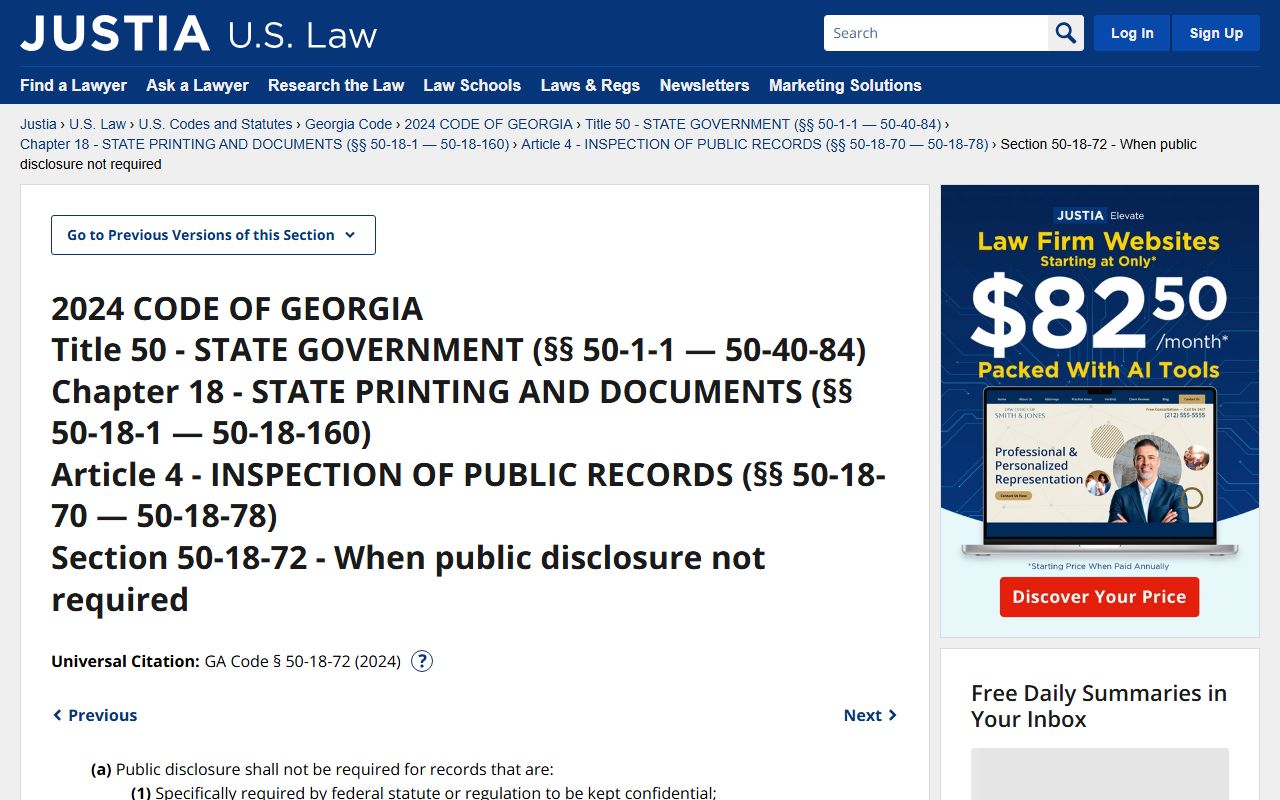
The Justia text shows the full list of exempt records and the rule that exemptions get a narrow read. The same section also tells you that if part of a record is exempt, the rest still has to come out.
What Records Are Public in Cobb County
Cobb County holds a wide range of public files. Court records sit at the top of the list. Most adult civil and criminal case indexes are open. Deeds and other real estate filings are open. Marriage licenses are open. Most Sheriff jail records are open. Some Probate filings are open, some are not. Each one lives with a different office.
- Superior Court case files: civil, criminal, divorce, name change, equity, real-estate filings.
- State Court case files: traffic, misdemeanor, ordinance, certain civil matters.
- Magistrate Court files: small claims, dispossessory, garnishment, warrant applications.
- Probate Court files: estate, guardianship, marriage license, weapons carry, mental-health commitments (last two carry extra rules).
- Real estate records: deeds, liens, plats, UCC filings, held by the Clerk of Superior Court.
- Sheriff inmate roster, booking detail, warrant inquiry, civil process records.
- District Attorney and Solicitor General public records, subject to the active-prosecution rule.
The county built a single hub to route public users to the right court tool. That hub is the search judicial records page on cobbcounty.gov. From there, links go out to the Superior Court Clerk records system, the State Court Records Search, the Magistrate Court Records Search, and the Probate Court tools. The Clerk of Superior Court also runs its own records search landing page for real-estate and court files.
Records Held by the Clerk of Superior Court
The Clerk of Superior Court is Connie Taylor. The office is one of four elected constitutional offices in each Georgia county. The Clerk holds the official files for Superior Court and a large slice of the county's real-estate record system. The main office sits at 70 Haynes Street, Marietta, GA 30090. Phone 770-528-1300. For the full duty list, see the official Cobb Superior Court Clerk about page or the office duties page.
This office is the right place to ask for divorce decrees, felony case files, civil case files, real-estate deeds, plats, UCC filings, and most family-law filings outside of probate. The clerk staff can help you find a file. They cannot read it to you. They cannot give legal advice. Most fee work is set by statute. The current Cobb fee table sits on the Superior Court Clerk fees page.
Note: Clerk staff can help locate records and explain filing mechanics, but they cannot tell you what to file or how to argue a case.
Records the Clerk of State Court Holds
The Clerk of State Court is Tahnicia Phillips. The office holds traffic case files, misdemeanor case files, certain ordinance matters, and a slice of civil filings. The address is 12 East Park Square, Marietta, GA 30090. Email statecourt@cobbcounty.gov. The office page lists case-search and traffic-citation tools. For the full official list, see the Cobb State Court Clerk page and the general information page.
The State Court Clerk runs the State Court Records Search, which you can reach through the county judicial hub. Public users go through a disclaimer page first. We pulled a screen of the post-disclaimer search form. Look at the official tool at courts.cobbcounty.gov to see the live form.
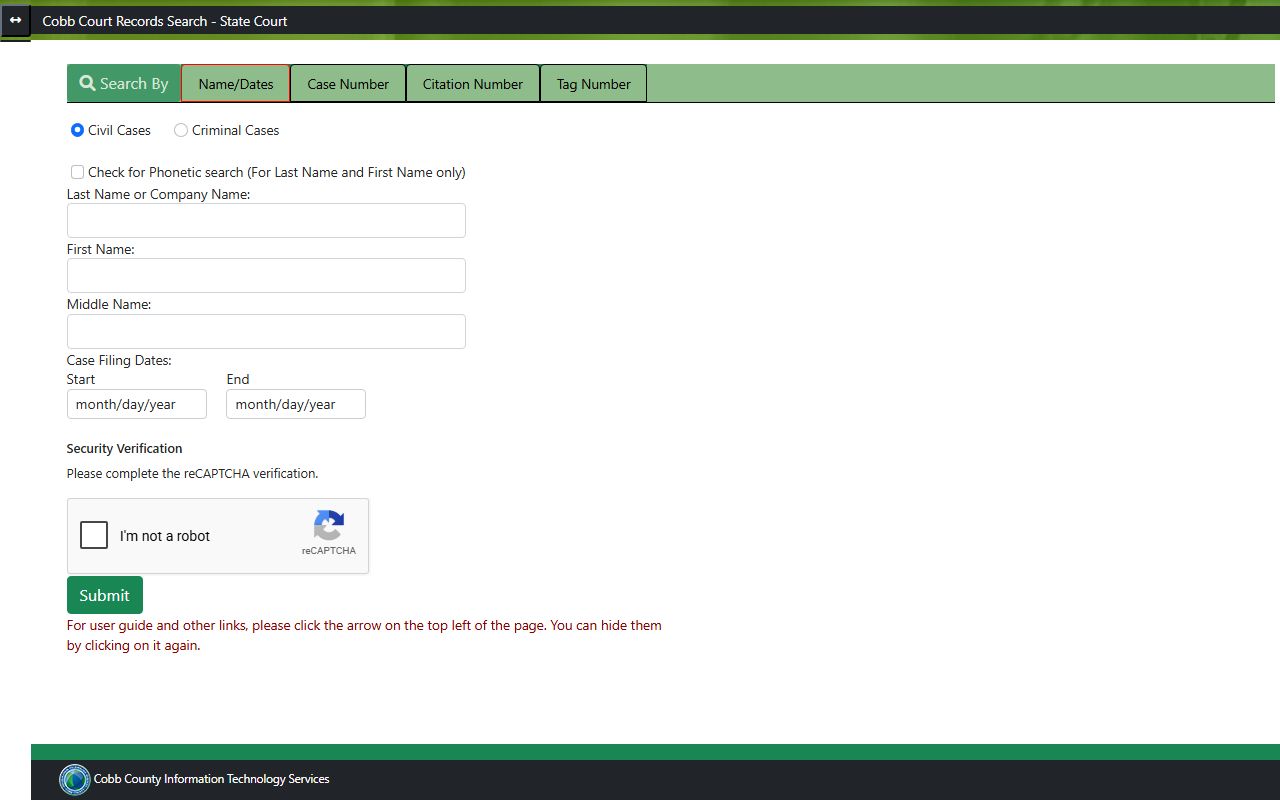
The form lets you search by name, case number, citation, or tag number. There is a phonetic option for last and first name. Civil and criminal modes split out at the top. Field options match the table below.
Public Records Request Form Fields
Most Cobb offices accept a short letter or email as a valid open records ask. There is no single form. A good request hits a few core fields. Use the list below as a template.
| Field | Required | Notes |
|---|---|---|
| Requester Name | Yes | State does not require a reason for the ask, but the office needs a name to reply. |
| Contact Method | Yes | Email is fastest. Phone or mail also work. |
| Description of Records | Yes | Be plain. Name the file, the topic, or the case. |
| Date Range | No | Speeds the search. Helps the office set a cost estimate. |
| Case or Booking Number | No | Best when known. Cuts search time to near zero. |
| Format Preference | No | Email, PDF, paper copy, certified copy. |
| Cost Cap | No | You can say "do not exceed $X without a quote." |
Note: A cost cap line saves time on both sides; the office can stop and ask before they run up a big bill.
Records Exempt from Disclosure under § 50-18-72
Not every file is open. Georgia law sets a list of exempt records. The list lives at O.C.G.A. § 50-18-72. The act tells judges to read each exemption in a narrow way. The agency must give you the parts that are not exempt, even if a few parts must come out.
- Active law-enforcement and prosecution files, while the case is open.
- Juvenile case data, fingerprints, photos, and names under O.C.G.A. § 15-11-702.
- Adoption files, sealed under O.C.G.A. § 19-8-23.
- Records that have been restricted under the state's record-restriction process at O.C.G.A. § 35-3-37.
- Mental-health commitment files held by Probate Court.
- Sealed court files held under judge order.
- Grand jury records.
- Personal data: Social Security numbers, bank and card numbers, medical data, minor names, protected victim data.
- Trial exhibits, with limits set by the statute.
Note: Each held-back record must be cited to a statute. If an office says no without a cite, ask for one in writing.
Response Timelines and Fees
Georgia law sets a clock. The office has three business days to answer. The answer is not always the file. It can be the file, a cost quote, or a list that needs more time. If the office needs more time, it must say so and set a date. The rule lives at O.C.G.A. § 50-18-71.
Fees follow a state framework. The office can charge for copies. It can charge for staff time spent on the search and retrieval. But there is a key carve-out. The first 15 minutes of staff time are free. After that, the office can bill at the hourly rate of the lowest-paid full-time employee who has the skill to do the work, not at a senior staff rate. The office must also send a cost estimate before it runs up a big bill.
| Item | Cost framework under § 50-18-71 |
|---|---|
| First 15 minutes of search/retrieval time | Free |
| Search/retrieval time after the first 15 minutes | Hourly rate of the lowest-paid full-time employee with the skill to do the work |
| Per-page copy fee | Set by the office; statute caps it at a reasonable amount tied to actual cost |
| Cost estimate before large work | Required when total cost will be more than $25 |
| Pre-payment / deposit | Allowed when total cost is set to top $500 |
| Electronic format | Same rules; format fee tied to actual cost to produce |
| Certified copies (court files) | Court clerks set their own fees by statute; see the Cobb Superior Court Clerk fee page |
Note: A fee waiver is not built into state law, but the office can choose to waive small fees on its own.
Court Records vs Other County Records
Court files and county agency files do not run on the same track. Court files are shaped by the Open Records Act, by court rules, and by judge orders. Agency files are shaped by the Open Records Act alone in most cases. The clerk of the right court is the first stop for case files. The agency itself is the first stop for non-court files.
A short rule helps. If the file came out of a case, ask the clerk who holds that court's records. For felonies, divorce, and real estate, that is the Clerk of Superior Court. For traffic and misdemeanors, that is the Clerk of State Court. For wills, estate, and marriage licenses, that is the Probate Court. For arrests, jail data, and warrants, that is the Sheriff. For deeds and property data, that is the Clerk of Superior Court real-estate division.
For court file searches that you can do online without a formal request, use the Cobb County court records page. For criminal background work, see criminal records. For marriage and divorce files, see marriage and divorce records. Each of those pages links out to the same official county tools.
If Your Request Is Denied
A denial has to come with a cite. The office must point to the statute that lets them hold the record. If the cite is missing, ask for it. If the cite is wrong, push back. Many denials are partial. The office holds part and gives part. That is the rule under § 50-18-72.
If a partial release does not work, the next step is a complaint or a civil action. Georgia gives superior courts the power to hear open records cases under O.C.G.A. § 50-18-73. The Georgia Attorney General also runs a mediation program for some open records and open meetings disputes. See the AG open-government FAQ for the current process.
Note: Most disputes get fixed by a second, narrower ask before a lawsuit is on the table.
Tips for a Good Cobb County Records Ask
Small things make a big difference. A clear, narrow ask gets a fast reply. A vague ask sits in a queue. Try the search tool first; if you find the file there, you may not need a formal request at all. If you do need to file, name the right office and name the right record. Always set a contact method that you check.
- Try the right court portal first. The judicial records hub routes you by court type.
- Use a case number or booking number when you have one.
- Ask for an electronic copy when paper is not needed; it cuts the cost.
- Set a cost cap line in the ask.
- Be patient on three-day clocks for big asks; the office may set a longer date.
- Keep the email chain; it is the record of the request.