
How to Search Cobb County Court Records
Cobb County publishes an official Search Judicial Records hub that routes users to the right court. Superior Court Clerk WebCaseManagement covers felony, divorce, domestic, child support, habeas, and major civil cases. The State Court Records Search covers misdemeanors, traffic, and many civil cases. The Magistrate Court Records Search covers small claims, dispossessory, garnishments, and warrant case types. Probate cases use a separate Probate Court case-status link.
Before starting a search, gather the full party name, any case number, and a rough filing date. The State and Magistrate portals limit a result set to the first 5,000 matches. Narrow searches return better data. The State Court portal also requires reCAPTCHA before a search runs.
- Open the right portal at the Cobb judicial records hub and pick the court that matches the case type.
- Accept the disclaimer. Enter a party name or case number. Use the format 24-A-12345 if the case number is known.
- Narrow by court type, case type, filing date range, or birth year. Phonetic search helps when a name spelling is uncertain.
- Pass the reCAPTCHA check and run the search. Click the arrow in the first result column for a quick view, then open Case Details for the full docket.
- Use the Documents button to view filings. Request a certified copy from the right clerk if a court-stamped copy is needed.
The official court record always controls if the portal disagrees with the paper file. Updates run nightly. Bulk scraping triggers a block under the portal terms.
Cobb County's official court overview lays out which division handles which case, and the information-about-courts page ties names, addresses, and phones to each office.
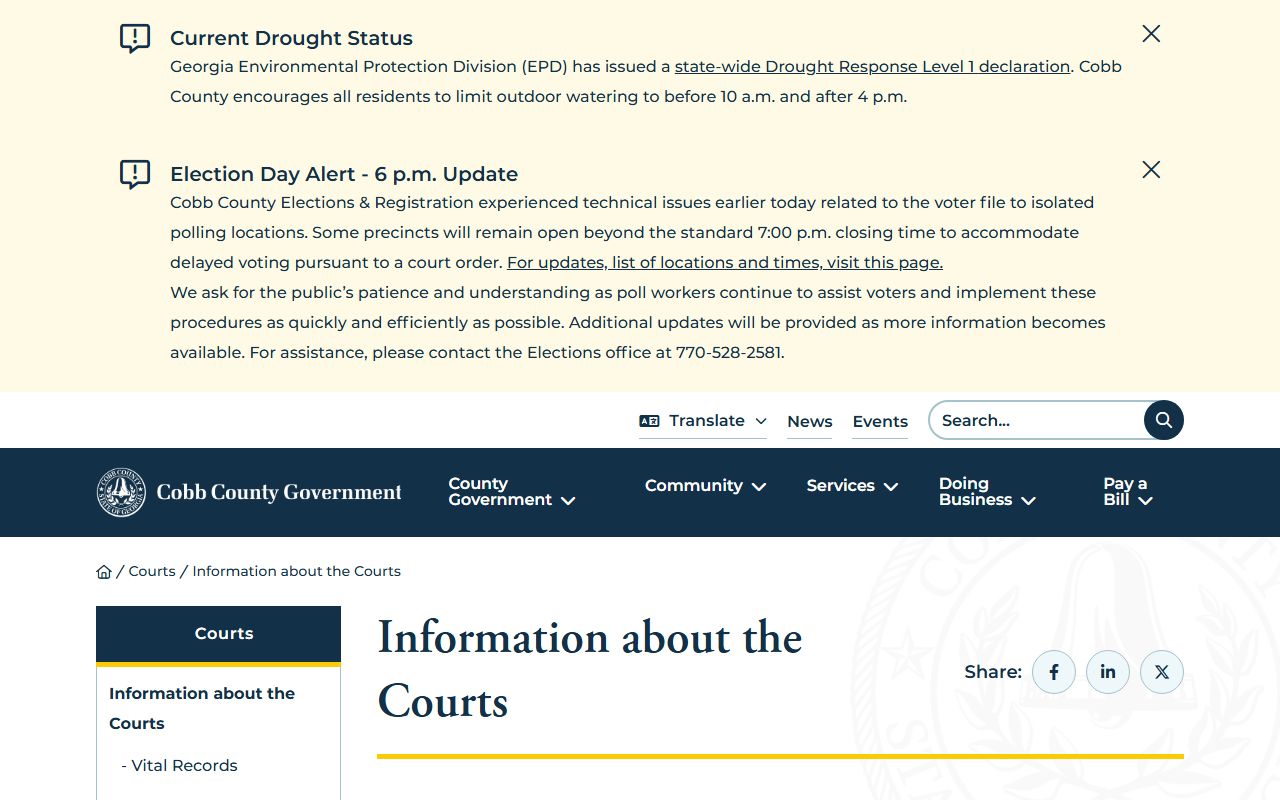
The same hub links the District Attorney, Solicitor General, and Law Library, so users can find the prosecutor or research office tied to a case.
The Cobb County Judicial System
Cobb County sits in the Cobb Judicial Circuit. The Superior Court is the general-jurisdiction trial court. State Court handles misdemeanor and traffic work. Magistrate Court handles warrants, small claims, and civil matters under $15,000. Probate Court handles wills, guardianships, marriage licenses, and weapons carry permits. Juvenile Court hears cases involving children under 18 under separate statutory rules.
Felony, divorce, and equity matters go to Superior Court. Misdemeanor cases and most traffic citations go to State Court. Small claims, evictions, and garnishments go to Magistrate Court. Estates and guardianships go to Probate Court. Appeals run to the Court of Appeals of Georgia and then to the Supreme Court of Georgia in some cases.
Case flow: Magistrate Court › State Court / Superior Court › Court of Appeals of Georgia › Supreme Court of Georgia
| Court | Jurisdiction | Case Types |
|---|---|---|
| Superior Court | General jurisdiction; ten elected judges | Felonies, divorce, title to land, equity, jury trials |
| State Court | Limited jurisdiction by statute | Misdemeanors, traffic, ordinance, broad civil |
| Magistrate Court | Limited jurisdiction; one of Georgia's largest | Small claims, dispossessory, garnishment, warrants |
| Probate Court | Exclusive over probate matters | Wills, guardianship, marriage, weapons carry |
| Juvenile Court | Children under 18 | Delinquency, deprivation, juvenile traffic |
| Municipal Court | City limits only | City ordinance and city traffic cases |
The State Court was created by the Georgia General Assembly in 1964. It began operating January 1, 1965. The official Georgia Courts site lays out the full state hierarchy at georgiacourts.gov.
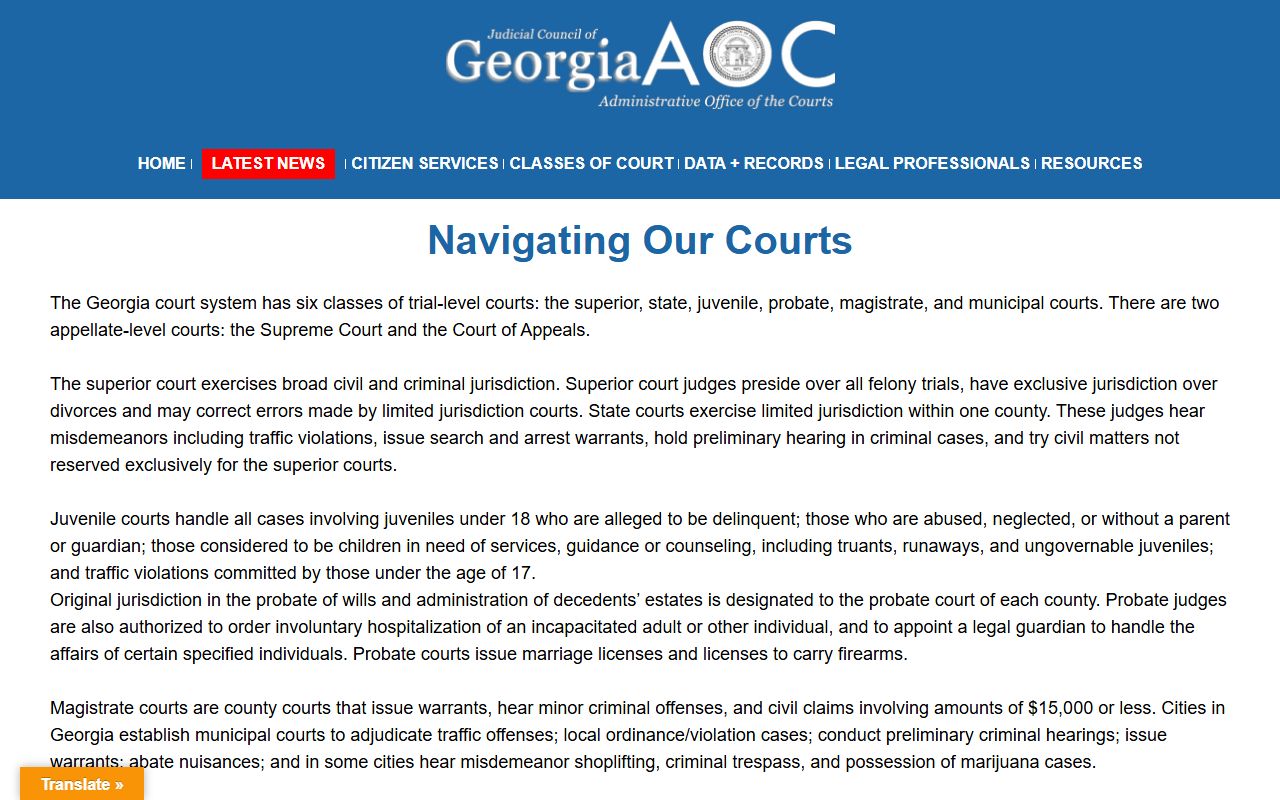
The Georgia Courts page shows where the Cobb County Court system sits within statewide trial and appellate structure.
Cobb County Courthouses
The Cobb County court complex is not one tower. It is a cluster of buildings around Marietta Square. Each court has its own door. Superior Court and the Superior Court Clerk share 70 Haynes Street. State Court sits at 12 East Park Square. Probate, Magistrate, Juvenile, and the Public Defender are at 32 Waddell Street.
Cobb Juvenile Court
32 Waddell Street, 5th/6th Floor
Marietta, GA 30090
(770) 528-2220
Sheriff staff secure all of these buildings under O.C.G.A. § 15-16-10. Plan for a security screen at each door.
Types of Court Records Available in Cobb County
Cobb County Court records split by case class and by the court that hears them. Civil files cover claims, answers, motions, orders, and judgments. Criminal files cover accusations, indictments, warrants, bond, dispositions, and sentences. Family files cover divorce, custody, child support, and legitimation. Each court keeps its own files and uses its own search portal.
Magistrate Court files include small claims, dispossessory, garnishment, abandoned vehicles, mechanic's liens, and warrant applications. State Court files include misdemeanor charges, traffic citations, and ordinance violations. Superior Court files cover felonies and divorce. Probate Court files include estates and guardianship matters.
- Criminal records - felony and misdemeanor case files from Superior and State Court.
- Civil records - claims, judgments, and post-judgment filings across multiple courts.
- Family and divorce records - filed and kept by the Clerk of Superior Court.
- Probate records - wills, estate administration, guardianships, and conservatorships.
- Traffic records - State Court traffic citation files and bond forfeitures.
- Warrant records - Magistrate Court arrest, bench, and search warrant data.
- Court dockets - filing-by-filing schedule of hearings and entries.
Juvenile records sit under separate statutes. They are not part of the regular adult search portals.
What Information Is Included in Cobb County Court Records
A Cobb County Court record can show a lot at once. The case number anchors the file. The party block shows who sued whom or who was charged. The docket lists each filing in order. Most public files end with a disposition or sentence entry.
Search results in the Cobb Superior, State, and Magistrate portals share a common look. Users can resize columns, filter columns, group results, drill into Case Details, and open documents in a new tab. The result set caps at 5,000 records, so wide name searches need extra filters.
| Field | What It Shows |
|---|---|
| Case Number | Court-assigned ID such as 24-A-12345. |
| Filing Date | When the case opened with the clerk. |
| Parties | Plaintiff and defendant or petitioner and respondent names. |
| Court Type | Superior Civil, State Civil, Domestic, Child Support, or Habeas Corpus. |
| Charges or Cause | Code section, count, and short description. |
| Disposition | Final outcome such as plea, verdict, dismissal, or bond forfeiture. |
| Sentence or Judgment | Fine, probation, jail time, or money award. |
| Documents | PDF filings linked from Case Details. |
Party addresses can be from the time of filing or a later case-management update. The court does not promise an address is current.
Public Access Laws for Cobb County Court Records
Georgia's Open Records Act sets the rule. Most adult court files are open. Some files are sealed or restricted. The Georgia Attorney General publishes plain-English guidance on open-government law and a public open-records FAQ.
Three sections of Title 50, Chapter 18 do the heavy lifting. Two other statutes shape criminal history and juvenile access. Each one ties to a public site that prints the full text.
Key Statutes:
Georgia Code § 50-18-70 - Sets the state policy that public records are open and defines what counts as a public record.
Georgia Code § 50-18-71 - Sets how fast an agency must respond, what copy fees apply, and how denials must be handled.
Georgia Code § 50-18-72 - Lists records that are not subject to disclosure, read narrowly.
Georgia Code § 35-3-37 - Allows record restriction of eligible criminal history for non-criminal-justice use.
Georgia Code § 15-11-702 - Limits how juvenile names, fingerprints, and photos can be shared.
Image of the AG open-government law page below.
The Attorney General's site posts the act and policy notes on its open-government page.
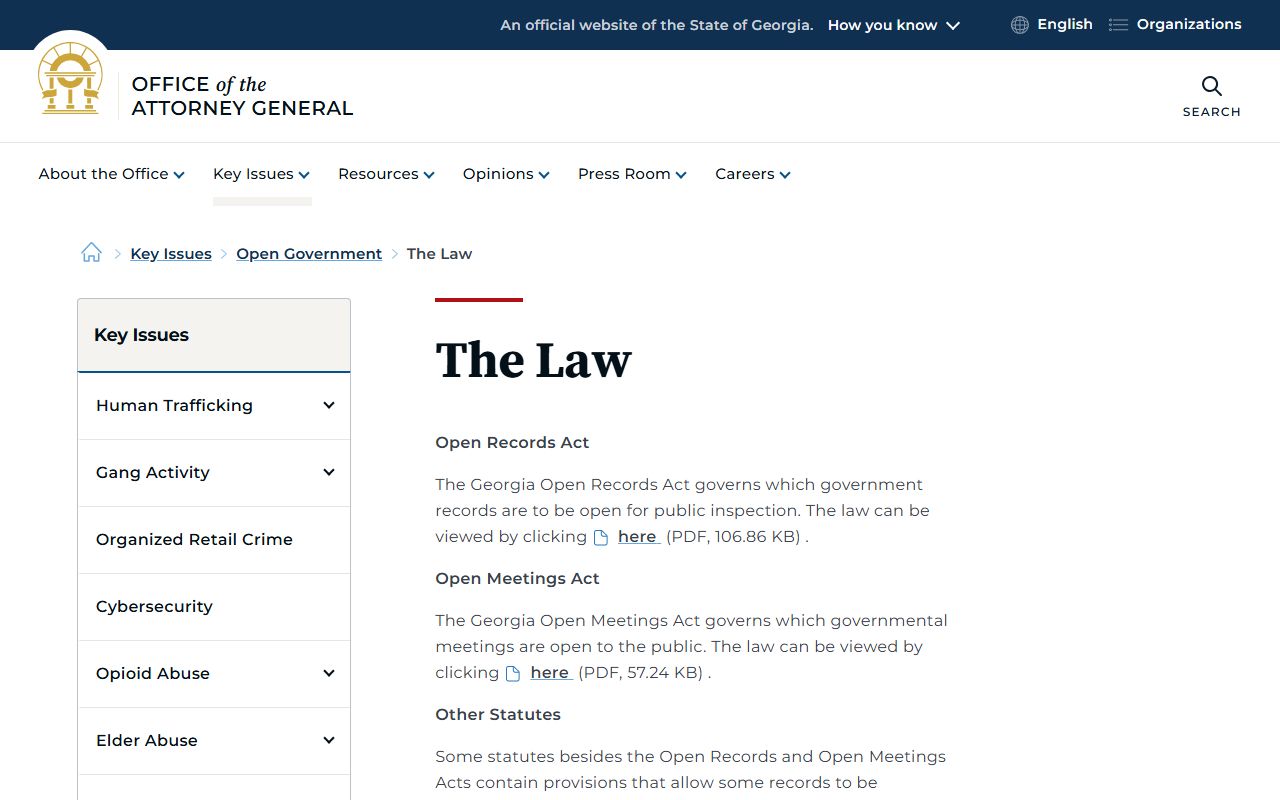
The page links the statute text and explains how the act applies to county agencies.
For common public questions, the AG also runs a short open-government FAQ.
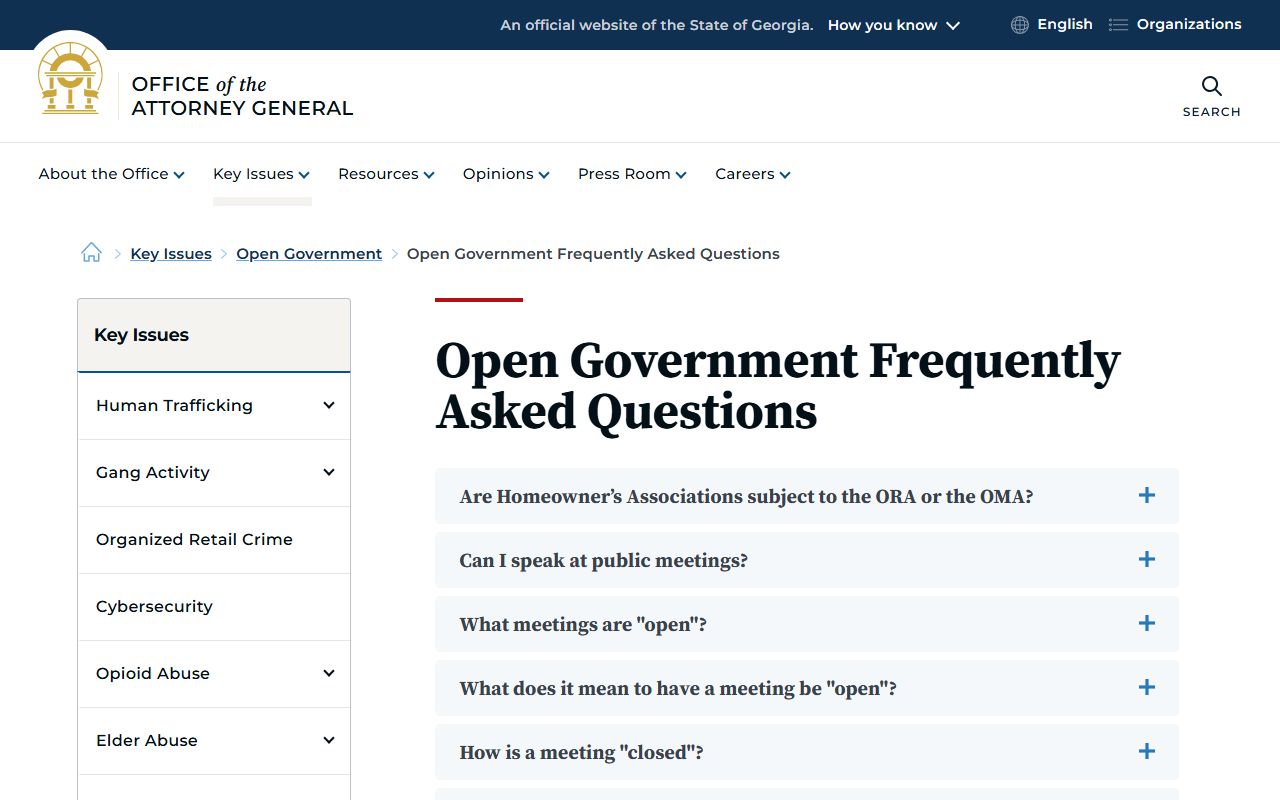
The FAQ walks through response times, allowed fees, and what to do if a request is denied.
Records That Are Restricted or Confidential
Not every court file is public. Some files are sealed by statute. Some are sealed by court order. Adoption files are sealed under Georgia Code § 19-8-23. Juvenile identifying records sit under O.C.G.A. § 15-11-702. Mental-health commitment files in Probate Court are restricted by law. Grand jury matters are secret by rule.
Georgia uses "record restriction" rather than full physical expungement. The process under O.C.G.A. § 35-3-37 hides eligible arrest data from public view but does not destroy the record. Older arrests before July 1, 2013 go through the arresting agency and the prosecutor. The Georgia Crime Information Center may charge a $25 fee after approval. The arresting agency may charge up to $50 for older cases. Most complete files take two to three weeks to process.
To inspect a sealed file, a party generally files a written petition under seal. The judge reviews in chambers and rules by order. Pro se petitions are allowed but a clerk cannot give legal advice.
Specialty Courts in Cobb County
Cobb Superior Court runs four accountability courts at 10 East Park Square, Suite 200. The Drug Treatment Court is a state-certified program for high-risk participants with substance use disorders facing felony charges. It runs 18 to 24 months across five phases. Judge Jason D. Marbutt presides. The phone line is (770) 528-1933.
The Mental Health Court takes part-time referrals at (770) 528-8106. The Veterans Treatment Court line is (770) 528-7988. The Parental Accountability Court line is (770) 528-3616. Each program asks for voluntary entry, team review, and a judge's approval before admission.
Benefits cited by the court include less jail time, possible charge reduction, evidence-based treatment, and help with housing, work, and family stability. Active sex offender status, serious violent felony charges, gang affiliation, and severe persistent mental illness are common exclusions.
Cobb County Sheriff and Jail Information
The Cobb County Sheriff runs the Adult Detention Center at 1825 County Services Parkway, Marietta. The complex holds A, B, and C Towers with a combined bed capacity of 3,077. Building A opened in 1987. Building B expanded the facility in 1997. C Tower opened in 2010 through a special sales tax. The Detention Division also covers a Work Deployment Facility and Annex.
Live custody data is on the official Cobb Sheriff inmate inquiry. The search asks for SOID, name, or serial number. Booking photos are not posted online under O.C.G.A. § 35-1-19. Full booking details, charges, bond, and release status are open to the public. See Cobb County inmate records for the full roster walkthrough and warrant records for active warrant lookups.
Marriage, Divorce, and Probate Records
Marriage licenses come from Cobb Probate Court. Divorce records are kept by the Clerk of Superior Court as part of Superior Court files. The split matters: a person looking to get married goes to Waddell Street, but a person looking for a final decree goes to Haynes Street. Both offices accept walk-in visits and online inquiries. See marriage and divorce records for the full breakdown.
- Testator
- A person who has made a valid will.
- Executor
- A person named in a will to settle the estate.
- Administrator
- A person appointed by the court when there is no will or no named executor.
- Conservator
- A court-appointed adult who manages another person's finances or property.
- Guardian
- A court-appointed adult who manages another person's care and personal choices.
- Year's Support
- A Georgia probate award setting aside property for a surviving spouse or minor child.
Cobb County Court Records Fees
Each clerk sets its own fees. The Superior Court Clerk handles felony, divorce, and major civil filings. The Probate Court handles marriage and estate filings. The Magistrate Court handles warrants, small claims, and evictions. The sample below pulls common amounts from the official fee pages.
| Item | Amount |
|---|---|
| General civil, divorce, adoption, name change (Superior) | $218.00 |
| Sheriff service per party (Cobb addresses) | $50.00 |
| Publication fee (Marietta Daily Journal) | $120.00 |
| Subpoena (Superior) | $5.00 |
| Marriage license without premarital counseling | $56.00 |
| Marriage license with proof of counseling | $16.00 |
| Certified copy of marriage license | $10.00 |
| Petition to Probate Will in Solemn Form | $202.00 |
| Probate certified copies (first page) | $10.00 |
| Probate certified copies (each added page) | $1.00 |
| Warrant application (Magistrate, cash only) | $20.00 |
| Bad check application (Magistrate, cash only) | $20.00 |
Superior Court Clerk accepts cash, money order, cashier's check, and card. A card payment in person needs the cardholder and a valid ID. Magistrate adds a $4 per case fee for card use.
Note: Fees change. Confirm the current amount with the right clerk before filing or mailing payment.
Superior Court Search Fields
The Superior Court Clerk WebCaseManagement portal uses a set list of fields. The civil search and the criminal search share most fields. The table below mirrors the official Cobb Superior Civil Search form. It helps a user know what to type before opening the portal.
| Field | Type | Notes |
|---|---|---|
| Case # | Text | Exact case number if known. |
| Party Name | Text | Person or business name. |
| CSE # | Text | Child support enforcement number. |
| System Wide Search | Text | Broad keyword or name search. |
| Filed From / Filed To | Date text | Datepicker mask mm/dd/yyyy. |
| Court Type Filters | Checkbox group | All, Domestic, Superior Civil, Child Support, State Civil, Habeas Corpus. |
| Search | Button | Runs the query. |
| Clear | Button | Resets the form. |
The State Court and Magistrate portals add reCAPTCHA, a phonetic name option, and a case-type dropdown.
How to Interpret Cobb County Court Records
Docket lines use short codes. A short code can hide a big deal. A "nolle prosequi" means the prosecutor dropped the case. A "dismissed with prejudice" entry means the case is gone for good and cannot be refiled. A "dismissed without prejudice" entry means the case is closed but may be refiled. A bond forfeiture on a traffic citation is the final disposition when an online payment is made.
A charge is not a conviction. An arrest record shows that a person was booked. A disposition entry shows what the court did with the case. Always read down to the sentence or judgment line before drawing any conclusion. An inactive party can still display in case detail with an end date in the Expiration Date field.
Code section numbers point to the Georgia Code. A charge marked O.C.G.A. § 16-13-30 covers controlled substances. A charge marked O.C.G.A. § 40-6-391 covers DUI. Use Justia or the official Georgia Code site to read the full text of any cited section.
Accuracy, Updates, and Record Limitations
The Cobb online portals refresh once a day. Today's filings show up the next day. The State Court and Magistrate disclaimers say the official court record controls in any conflict. Bulk scraping can trigger a permanent block. Use the portal for individual lookups, not data mining.
Address fields can be from the time of filing. They may not reflect a current residence. Inactive parties may show with an end date in the Expiration Date field. The State Court Clerk does not run broad record searches by phone. Users should search the portal first and then call (770) 528-2660 with a specific case number.
Note: Always confirm key dates and case details with the clerk before relying on an online record for legal action.
History of Cobb County Courts
Cobb began without a jail. A first jail went up in 1846, thirteen years after the county itself. War burned that jail in 1864. Through the late 1800s and the early 1900s, Cobb relied on temporary holding sites. By the late 1960s, the county ran a 128-bed jail on the top floor of a public safety building on Washington Avenue.
Overcrowding in the 1980s and a federal court order pushed the county to build a new jail. The bond referendum passed. The new facility opened on County Farm Road, later renamed County Services Parkway. The Cobb State Court itself started January 1, 1965, after a 1964 act of the Georgia General Assembly. It began as the Civil and Criminal Court of Cobb County. In February 2026, Cobb opened the first drive-through court service in Georgia for State and Magistrate Court fine payments.
Self-Help and Legal Aid Resources
Self-represented users have several options in Cobb. The Cobb County Law Library at 70 Haynes Street, Fourth Floor, helps pro se litigants, attorneys, and the public. Hours are Monday through Friday, 8 a.m. to 5 p.m. The phone line is (770) 528-1884. The library is a research stop, not a substitute for a lawyer.
The Superior Court forms page links family-law packets, name change forms, contempt forms, and a poverty affidavit. Magistrate Court accepts pro se small claims under $15,000. The Cobb Circuit Public Defender at 32 Waddell Street covers court-appointed criminal defense at (770) 528-1950. The Cobb Bar Lawyer Referral Service offers a 30-minute consultation for a $40 upfront fee. Legal Aid of Cobb County at (770) 528-2565 may help low-income residents with certain civil matters.
Courthouse Location and Contact
The main courthouse contact card below covers the Superior Court Clerk's office. This is the right stop for felony case files, divorce decrees, real-estate records, and most major civil records. State Court, Magistrate, and Probate sit in nearby buildings around Marietta Square.
Clerk of Superior Court
Connie Taylor, Clerk
70 Haynes Street
Marietta, GA 30090
(770) 528-1300
Mon-Wed 8 a.m.-5 p.m.
Clerk of State Court
Tahnicia Phillips, Clerk
12 East Park Square
Marietta, GA 30090
(770) 528-2660
Mon-Fri 8 a.m.-5 p.m.
Sheriff Adult Detention Center
1825 County Services Parkway
Marietta, GA 30008
(770) 499-4200
Frequently Asked Questions
How do I search Cobb County court records online?
Start at the Cobb judicial records hub and pick the right court for the case type. Superior Court Clerk WebCaseManagement covers felony, divorce, and major civil matters. State Court Records Search covers misdemeanor and traffic cases. Magistrate Court Records Search covers small claims, evictions, garnishments, and warrant case types. Probate Court has a separate case-status link. The portals refresh nightly and require reCAPTCHA on submit. See Cobb County court records for the full walkthrough.
What court handles felony cases in Cobb County?
Felony cases go to Cobb Superior Court at 70 Haynes Street, Marietta. The District Attorney prosecutes those cases. The Superior Court Clerk keeps the case files and the docket. A felony case search should start with the Clerk's WebCaseManagement portal. Use the criminal search tab and enter a defendant name or case number. The Superior Court also has exclusive jurisdiction over divorce, title-to-land, and equity matters.
What court handles misdemeanors and traffic tickets?
Cobb State Court handles traffic, misdemeanor, ordinance, and many civil cases under state law in unincorporated Cobb County. The Solicitor General prosecutes traffic and misdemeanor cases. The State Court Clerk maintains the records and collects fines and fees. City tickets from Marietta, Smyrna, Powder Springs, Acworth, Kennesaw, or Austell go to the matching municipal court. See Cobb County traffic court records for a deeper walkthrough.
Why are Cobb jail booking photos not shown online?
The Sheriff inmate inquiry page states that booking photos are no longer posted on the Sheriff's website. The change followed O.C.G.A. § 35-1-19. Inmate search results still show name, DOB year, race, sex, location, SOID, and days in custody. Charge data, bond, and release status remain public on the booking detail page. The Image column appears in results, but the field is blank.
How do I look up warrants in Cobb County?
Online warrant inquiry access is limited to State Bar of Georgia members. Public users should call Magistrate Court at (770) 528-8900 or Sheriff Warrant Information at (770) 499-4634. An attorney with an account can search by login at the warrant inquiry page. The site says it works best on IE11 or Chrome and asks users to allow pop-ups. See warrant records for the full process.
Can a Cobb State Court traffic ticket be paid online?
Some can. The State Court traffic page says not all cases can be paid online. Some need a mandatory court appearance. If a payable citation is paid online, the bond amount is forfeited on the court date and serves as final disposition. Wait 10 to 14 business days after receiving the ticket before trying to pay or search. If the case is still not found after 14 business days, call the Clerk at (770) 528-2660.
Where do I get a marriage license or a divorce decree in Cobb?
Marriage licenses come from Cobb Probate Court at 32 Waddell Street. The license fee is $56 without premarital counseling or $16 with proof of counseling. Bring a printed copy of the completed application. Divorce decrees are Superior Court records. Contact the Clerk of Superior Court at 70 Haynes Street or use WebCaseManagement. See marriage and divorce records for the full guide.
Can clerks give legal advice?
No. The Superior Court Clerk duties page says clerks and deputy clerks are forbidden from practicing law. They cannot give legal advice. They can help locate a record, explain filing mechanics, and accept a filing. For legal strategy, contact a private attorney, the Cobb Bar Lawyer Referral Service at (770) 424-2947, or the Cobb Circuit Public Defender for qualifying criminal matters. The Law Library on the fourth floor of 70 Haynes Street is a research stop.
More questions live on the Cobb County Court Records FAQ page.